

Improve the Network Conditions For AI Inference
FGN combines the Federated Gig Network and Performance Intelligence to help AI providers evaluate users, compute locations, network paths, delivery conditions, and application response.
What FGN works on
Real-time AI connects digital intelligence to physical infrastructure
AI inference increasingly operates beyond a browser or mobile screen. Industrial cameras inspect products. Robots navigate shared spaces. Drones analyze changing conditions. Sensors identify anomalies. Autonomous equipment responds to its environment. In each case, performance depends on the complete path connecting the endpoint, network, application, and compute environment.
This is consistent with current industrial-edge development, where AI is being used for robotics, industrial vision, predictive analysis, safety monitoring, and real-time automation. The model, the hardware and the software stack are the provider's domain. The path between the endpoint and the compute location is where FGN can observe, evaluate and act.
The path an inference request actually takes
From the endpoint to the compute, and back again.
An endpoint may be a person using an interactive AI application, an industrial camera, a fixed sensor, a mobile robot, an autonomous vehicle, a drone, a machine controller, a remote inspection device, a connected piece of equipment, or a distributed application or agent. Every stage below is somewhere conditions can change.
Person, machine, sensor, or autonomous endpoint
A person using an interactive application, an industrial camera, a fixed sensor, a mobile robot, a vehicle, a drone, a machine controller, or a connected piece of equipment.
Access or industrial network
The request or data stream enters the access network, campus network, or industrial network serving that location.
Federated Gig Network
Participating networks provide more than one way to reach a compute destination.
Performance Intelligence
Latency, jitter and packet loss are observed across available paths so path selection reflects current conditions.
Edge or cloud compute
The workload reaches the compute location being evaluated, whether that is on-premises capacity, operator edge, a regional edge site, or a distant cloud region.
Application, machine, or operational response
The result returns to an application, an operator, a controller, or an autonomous endpoint. What matters is the complete round trip, not any single leg of it.
Where responsibility sits
FGN works in the network path. Federation members own the networks and machines.
The selected network path is one part of the overall system. Endpoint compute, application architecture, model behavior, safety controls, and machine-control logic remain the responsibility of the applicable technology and operating partners.
As conditions change, FGN can reevaluate available paths and select a different path based on the workload's current needs.
Physical AI and industrial systems
Inference performance matters wherever machines must perceive, decide, or respond.
The network may carry sensor streams toward compute, inference results back toward equipment, coordination data between machines, or operational context between an edge site and a cloud platform. Delays, loss, congestion, and unstable paths can affect how quickly and consistently the complete system exchanges information.
Robotics and Autonomous Mobile Systems
Perception, navigation, coordination, inspection, and task execution.
Drones and Remote Inspection
Video analysis, object detection, mapping, infrastructure inspection, and changing mission conditions.
Industrial Vision
Quality inspection, defect detection, safety monitoring, OCR, and three-dimensional analysis.
Sensors and Industrial IoT
Anomaly detection, predictive signals, environmental monitoring, and equipment telemetry.
Autonomous and Connected Vehicles
Perception services, fleet coordination, infrastructure interaction, and remote operational support.
Remote Machines and Field Equipment
Agriculture, utilities, logistics, construction, energy, and distributed industrial operations.
These applications reflect the wider physical-AI and industrial-edge ecosystem, which combines sensors, intelligent devices, robotics, edge computing, and cloud coordination.
Workload illustrations
What the exchange looks like for each workload.
Each illustration describes how a workload uses the network, so the performance requirement can be discussed in the terms of the application rather than the terms of the transport.
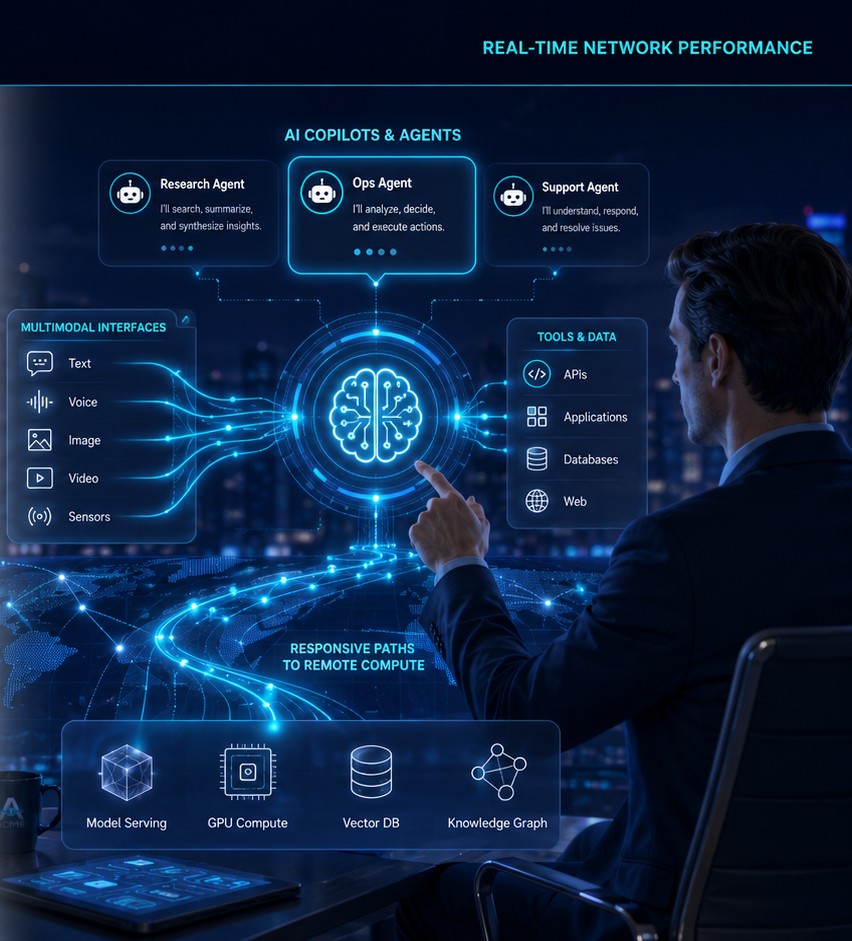
AI agents and interactive inference
Interactive inference, multimodal agents and machine decision systems that depend on responsive access to remote compute.
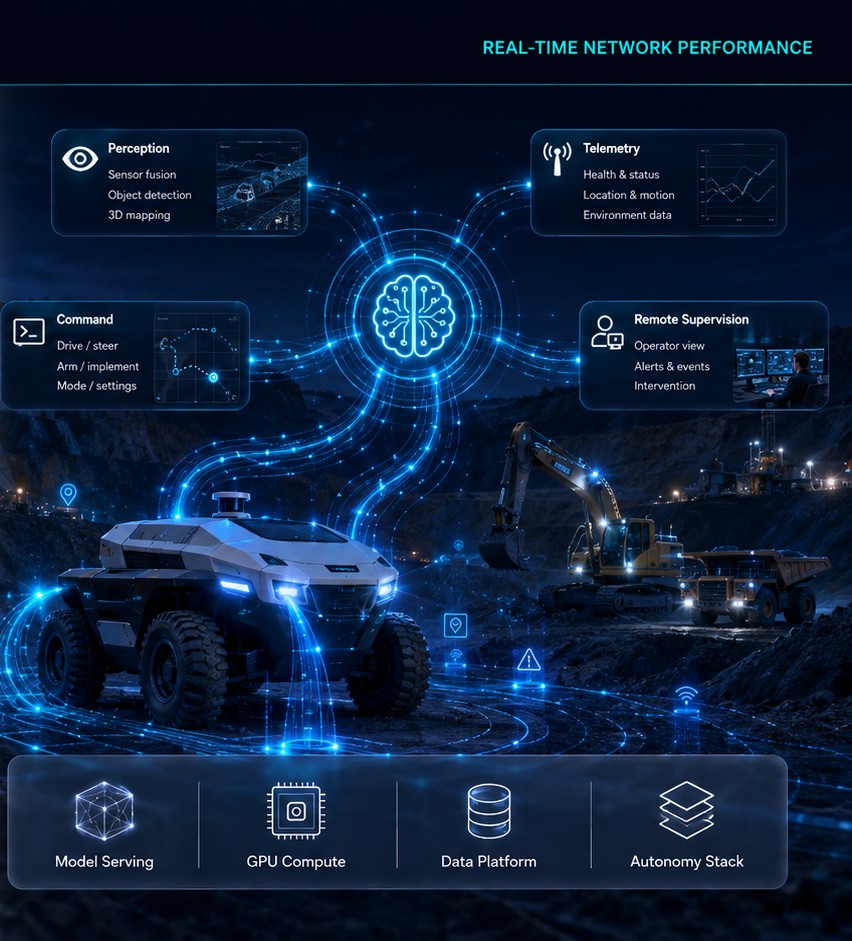
Autonomous machines
Autonomous equipment and vehicles that require low latency telemetry, decision support and a reliable command path.
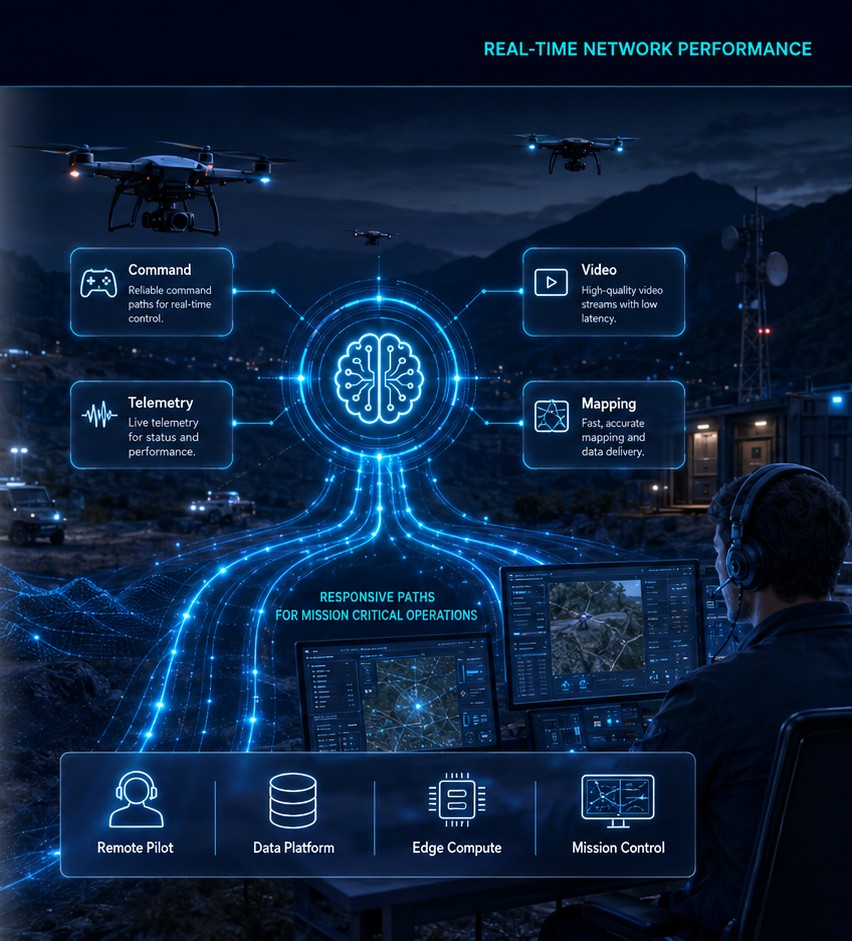
Drones and remote operations
Inspection, logistics, public safety and field operations where video, telemetry and control traffic must stay responsive and consistent.
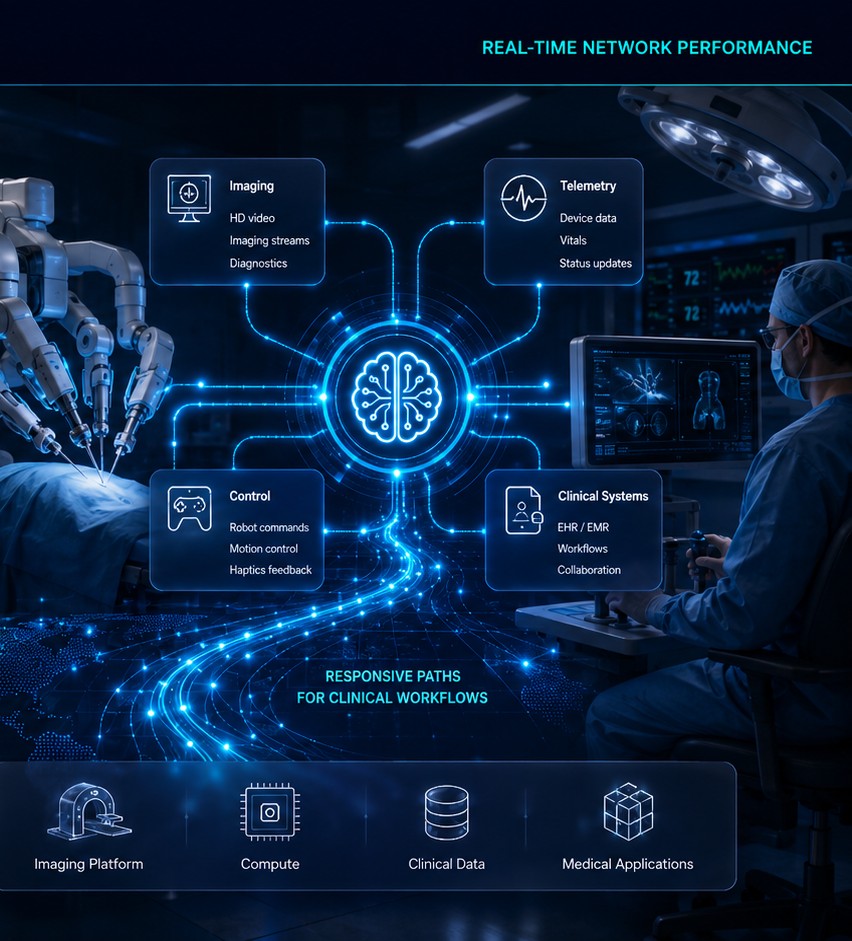
Medical robotics and clinical systems
Robotic assistance, remote diagnostics and imaging where network delay and instability affect operator responsiveness.
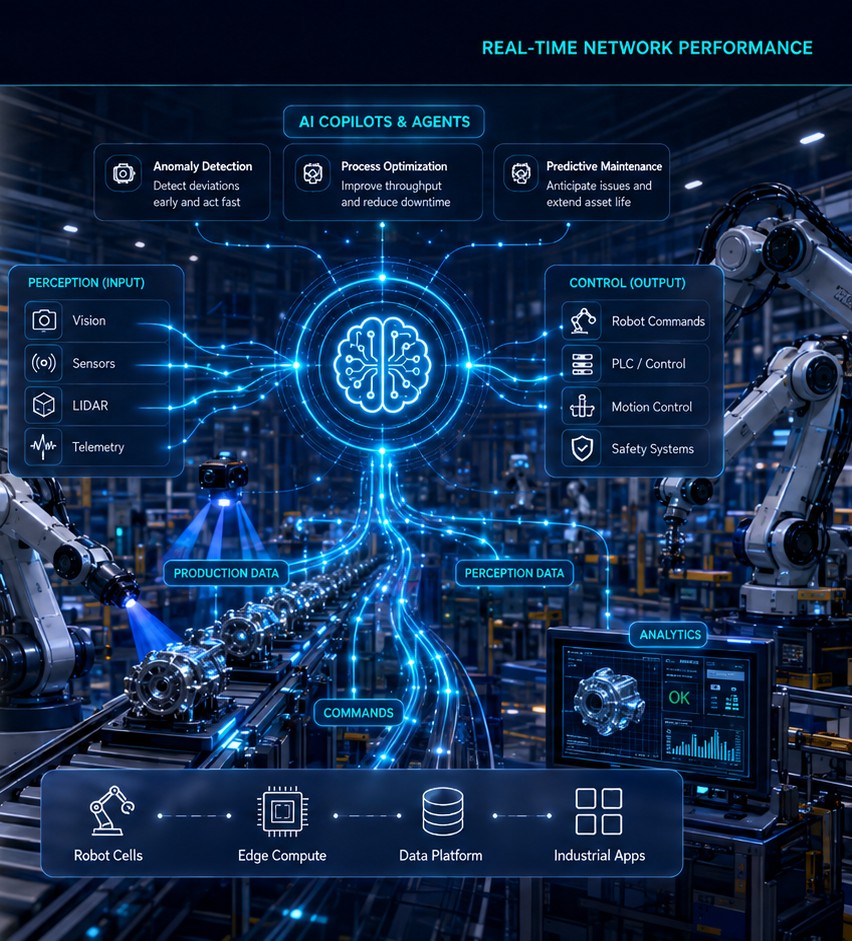
Industrial robotics and machine vision
Robotics, machine vision and industrial control workflows that depend on network behaviour that feels deterministic.
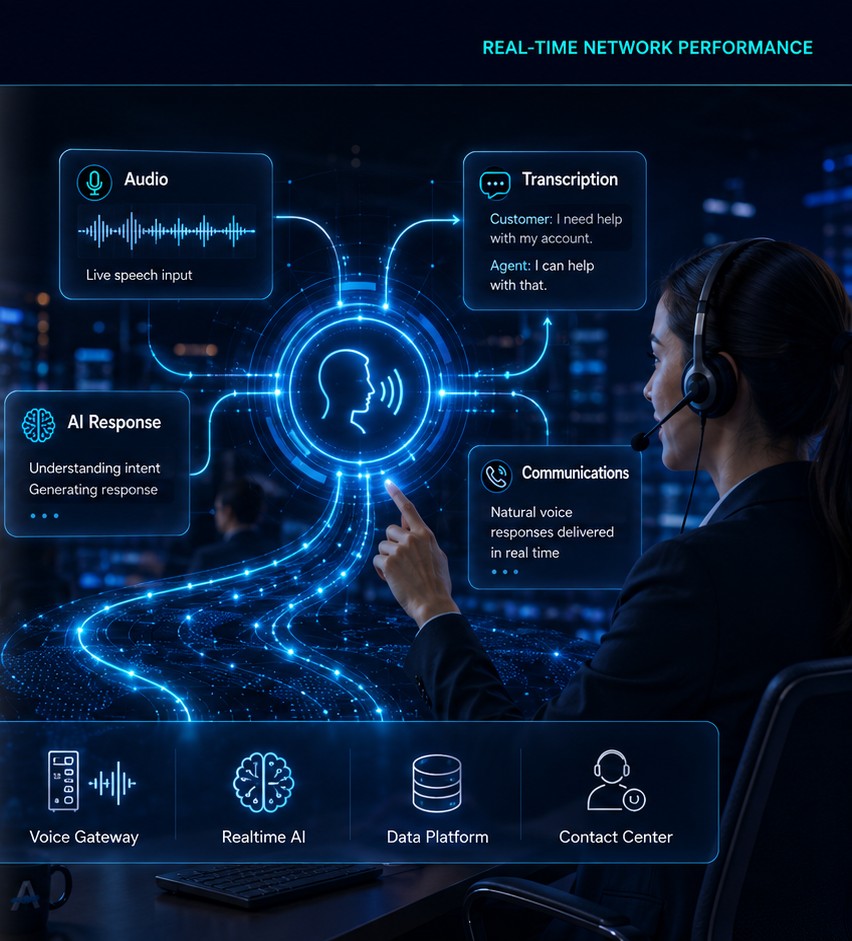
Voice AI and communications
Conversational systems, contact centres, voice and video where latency, jitter and loss are immediately visible to users.
Illustrations are explanatory. They describe workload behaviour and are not measured results.
Both directions matter
Data travels toward compute, and results travel back.
A pilot measures the complete exchange rather than a single leg of it.
Upstream
What the endpoint sends toward inference.
- Camera, sensor, robot, drone, vehicle, or machine
- Telemetry, images, video, position, or operating state
- Network path
- Edge or cloud inference
Downstream
What comes back once inference has run.
- Inference result, alert, instruction, updated model context, or coordination message
- Network path
- Application, operator, controller, or autonomous endpoint
The direction, volume, timing, and criticality of traffic depend on the application architecture and operating environment.
Not all machine-control traffic is cloud-based. Some inference and control remain on-device or on-premises, while other workloads use hybrid edge and cloud architectures.
Where connectivity sits
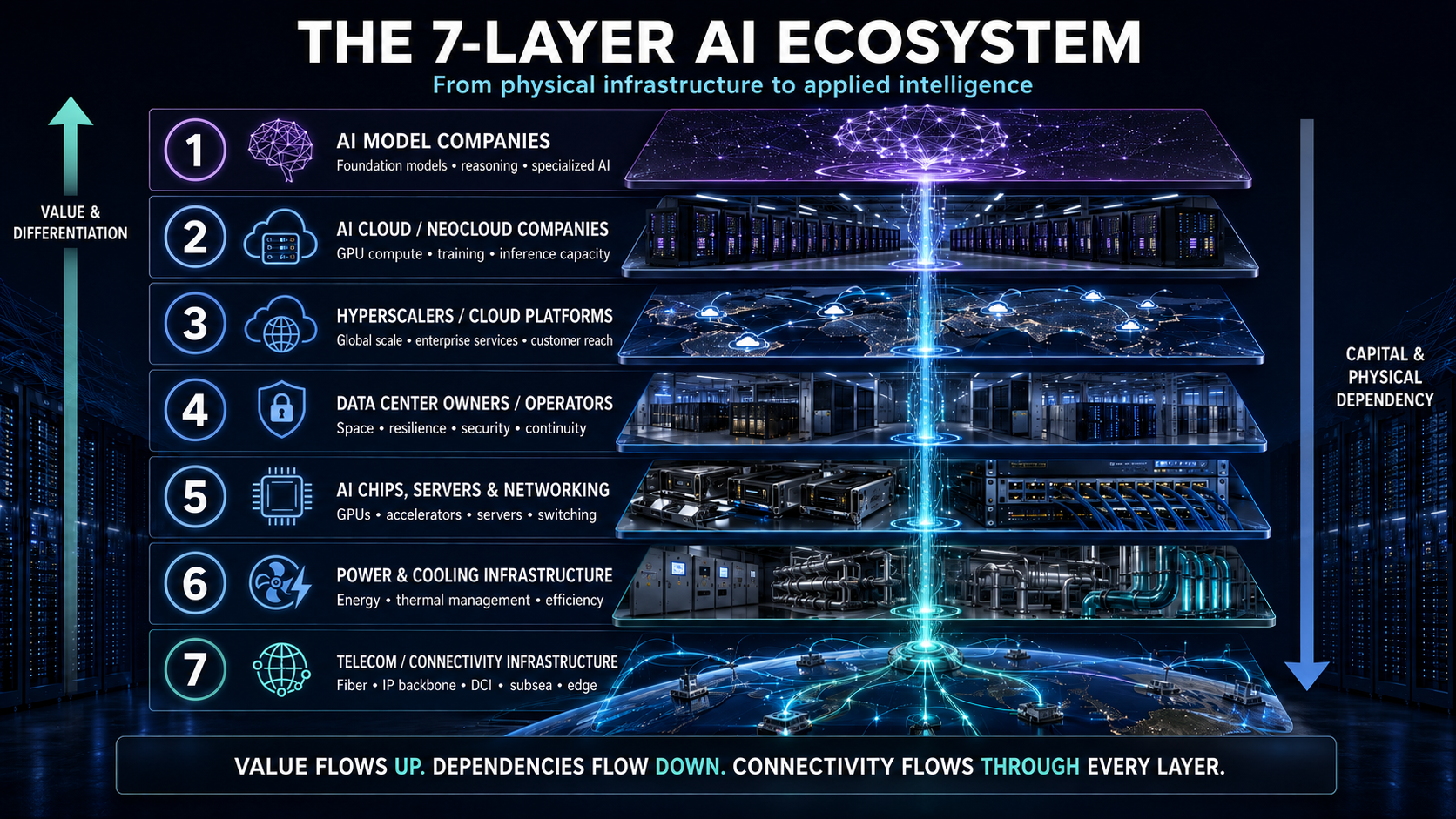
The AI ecosystem depends on every layer beneath it.
Value flows up. Dependencies flow down. Connectivity flows through every layer.
What gets measured
AI performance extends beyond the model and beyond the data center.
These factors are observed together, because improving one in isolation does not necessarily change the response an endpoint actually sees.
- Endpoint conditions
- Device capability, mobility, connectivity, radio conditions, sensor rate, and operating environment.
- Access-network conditions
- Local congestion, packet loss, jitter, latency, and service consistency.
- Path conditions
- The network route between an endpoint, application service, and selected compute destination.
- Compute placement
- On-device, facility edge, operator edge, regional edge, cloud, or hybrid infrastructure.
- Workload behavior
- Model size, input rate, batch behavior, inference frequency, and response requirements.
- Application architecture
- Whether the workload supports a person, coordinates machines, analyzes sensor streams, or contributes to an autonomous process.
- Operational response
- What happens after inference, including visualization, alerting, machine coordination, workflow action, or human review.
AI performance extends beyond the model
The model is one factor among several.
A request leaves a user, crosses an access network, travels a path to a compute location, and returns as a response the person actually experiences. Latency, jitter and packet loss along that path shape how the application feels, alongside the model and the compute environment.
Network performance is not the only factor in AI response. It is the factor FGN can evaluate and act on, in the context of a defined pilot with an agreed baseline.
User and application
Where the person is, and what the application expects from the network.
Network path conditions
Latency, jitter and packet loss observed across the available paths.
Compute location and response
Where inference runs, and how the response returns to the person waiting for it.
Build the pilot around the application
What a pilot needs before it can mean anything.
These inputs are agreed before measurement begins so the results can be interpreted against something defined rather than something assumed.
- ApplicationThe specific workload being evaluated and what a good experience looks like for it.
- Users and geographyWho is being served, and where those users are located.
- Compute platform and destinationsWhere inference runs and which destinations traffic must reach.
- Baseline and network conditionsThe current observed conditions the pilot will be compared against.
- Success criteriaThe agreed definition of a meaningful result for this application.
- Measurement periodHow long the pilot runs, and over what conditions results are collected.
From network assessment to deployment decision
What an AI provider can take away from the pilot.
A clearer view of delivery conditions
Better understanding of how the application is currently being delivered to real users.
Path and geography opportunities
Identification of paths or locations where conditions differ meaningfully.
Better informed pilot design
A stronger basis for the next round of testing and for what to measure.
Comparison of user and compute locations
A view of how different pairings of users and compute locations behave.
Planning for further testing or deployment
Inputs for the decision about where and how to expand.
Design the right AI performance pilot
Design the right AI performance pilot.
A short conversation covers the application, the users, the compute environment, the baseline and the measurement methodology that would make the results meaningful.
How a pilot runs
Build the pilot around the workload, endpoint, and operating environment.
Every input is agreed in advance so the result can be interpreted against something defined rather than something assumed.
- Application or industrial workload
- Endpoint type
- Human, machine, or autonomous interaction
- Geography and operating area
- Mobility requirements
- Sensor, image, video, or telemetry flows
- Current access-network environment
- Edge and cloud compute locations
- Destinations and available paths
- Baseline latency, loss, jitter, and response behavior
- Operational success criteria
- Measurement period
- Safety and control boundaries owned by the application partner
Industrial pilot examples
Examples of how a pilot can be scoped.
These are illustrative pilot designs rather than statements of product availability.
- Autonomous inspection pilot
- Evaluate the paths connecting field cameras or drones with an inference service used to identify anomalies or inspection targets.
- Robotics coordination pilot
- Compare network conditions between robots, facility infrastructure, orchestration services, and edge or cloud compute.
- Industrial vision pilot
- Measure the delivery conditions surrounding image or video inference for quality, safety, or operational monitoring.
- Distributed sensor pilot
- Evaluate how geography, connectivity, compute placement, and path conditions affect time-sensitive sensor analysis.
- Connected equipment pilot
- Compare inference delivery across multiple sites, access networks, or compute destinations supporting remote equipment or machine workflows.
What a pilot produces
From network assessment to an informed deployment decision
A pilot ends with observed conditions and a defined baseline, so the next decision can be made from measurement rather than assumption.
- Understand current endpoint-to-compute conditions
- Compare edge and cloud destinations
- Identify geographic and path variation
- Evaluate stationary and mobile operating scenarios
- Compare human-facing and machine-facing workloads
- Identify where additional edge placement or testing may be useful
- Establish a baseline for future pilots
- Inform application, infrastructure, and deployment planning
Pilot results depend on the application, endpoint, sensors, mobility, geography, destinations, compute environment, model and application architecture, network conditions, baseline, and agreed measurement methodology. FGN does not replace application-level safety systems, machine controls, or operational validation.
Start with the workload
Different workloads need different things from the network.
Select a workload type to see what a pilot would focus on.
Response time is the experience.
For interactive assistants, the wait between a request and the first part of a response is what the person notices. Path conditions between the endpoint and the compute location contribute to that wait.
- Time to first response matters more than raw throughput
- Consistency matters as much as the average
- Endpoints are distributed, so geography shapes results
- Baseline before and after the same way to compare fairly
Continuous streams expose instability quickly.
Workloads that send continuous audio, video or sensor data are sensitive to jitter and packet loss as well as latency, so the pilot needs to measure stability rather than a single figure.
- Jitter and loss can matter more than average latency
- Sustained conditions matter over a measurement period
- Compute proximity can change the observed result
- Success criteria are defined per stream type
Machine endpoints move, and conditions move with them.
When the endpoint is a robot, a drone, a vehicle or a piece of field equipment, mobility and radio conditions become part of the measurement. The pilot observes the network conditions around the workload; machine behavior and safety controls stay with the operating partner.
- Measure stationary and mobile operating scenarios
- Observe upstream telemetry and downstream results together
- Compare facility edge, operator edge and cloud destinations
- Record conditions per site and per operating area
Where inference runs is part of the design.
When inference can run in more than one location, the pilot compares those options under a common methodology instead of assuming that the nearest location is always the better one.
- Compare candidate compute locations directly
- Evaluate path quality alongside proximity
- Identify markets where conditions differ meaningfully
- Plan expansion from observed conditions
Not every workload needs the same path.
Workloads that are not interactive have different requirements. As conditions change, FGN can reevaluate available paths and select a different path based on the workload's current needs.
- Requirements defined per workload rather than globally
- Path selection reflects current conditions
- Measurement window matched to how the workload runs
- Results reported against the agreed baseline
Frequently asked
Straight answers.
Does FGN make inference faster?
FGN works on the network conditions surrounding inference delivery. Any performance statement is tied to a defined pilot, an agreed baseline and a stated measurement methodology.
What does FGN need from us to start?
The application, the user population and geography, the compute platform and destinations, the current baseline, the success criteria and the measurement period.
How does path selection work during a pilot?
As conditions change, FGN can reevaluate available paths and select a different path based on the workload's current needs.